A flashcard deck can fail quietly. The cards look fine, you review them every day, your accuracy is high — and then the exam asks the same content in a slightly different shape and none of it comes out.
That's almost always a card-writing problem, not a studying problem. These eight rules are the ones that make the biggest difference.
1. One idea per card
The most common mistake is the card that asks four things at once. "Describe the stages of mitosis" isn't a flashcard, it's an essay prompt. You'll get it partly right every time, which means you can never honestly rate it, which means the scheduler can never learn anything useful about it.
Split it. Five small cards each get their own schedule and their own honest rating.
2. Ask a question, don't state a fact
"The mitochondrion — the powerhouse of the cell" is a label. "What supplies most of a cell's ATP?" is a retrieval attempt. The second one makes your brain do work, and the work is the entire point.
If the front of the card doesn't end in a question mark or a blank, look at it twice.
3. Make the answer short and unambiguous
If you have to decide whether what you said "counts", the card is too vague. Short answers let you rate honestly, and honest ratings are what the scheduler runs on.
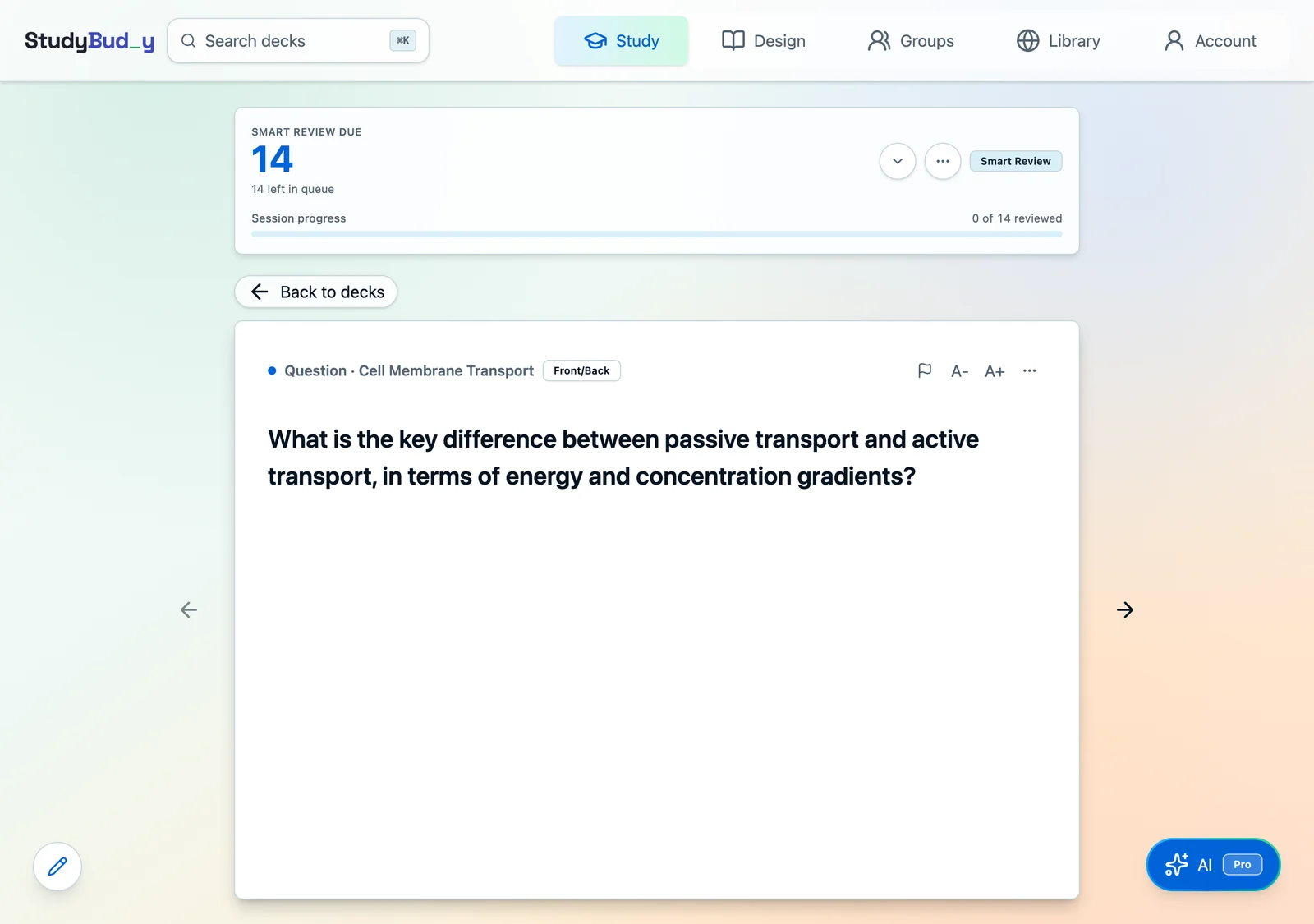
4. Use fill-in-the-blank for definitions and lists
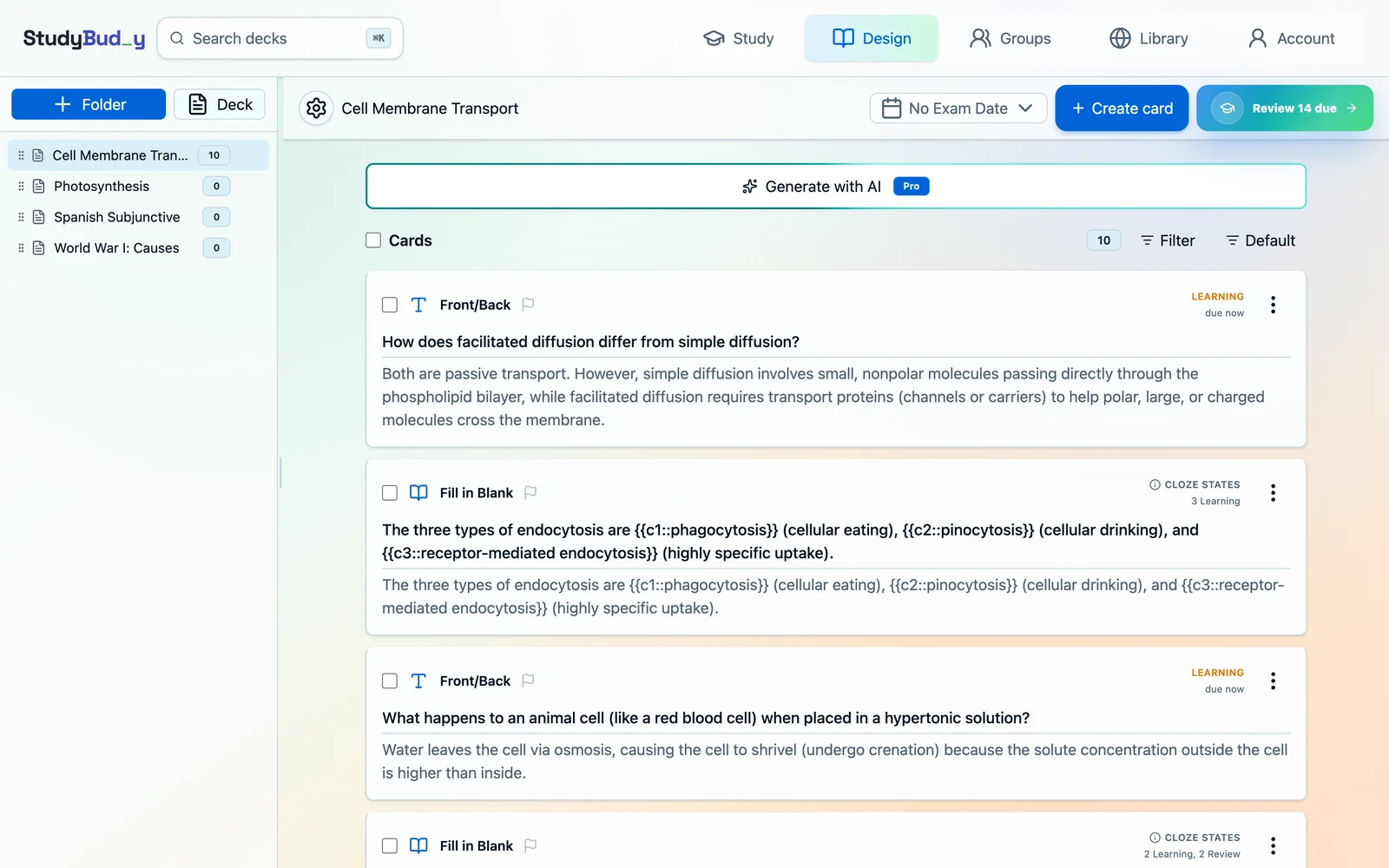
Some material resists the question format — definitions, sequences, formulas. Cloze deletion handles these well: you hide terms inside a sentence and recall them in context.
The detail worth knowing is that each blank is scheduled independently. Hide three terms in one sentence and you get three separate study cards, each with its own due date and its own memory state, even though you only wrote the sentence once.
5. Write in your own words
Copying a textbook sentence verbatim gets you a card you can recognise without understanding. Rephrasing forces you to process the idea once at writing time — which is itself a study session — and produces a card that tests meaning rather than word order.
6. Don't make cards for things you don't understand yet
Flashcards are for retaining things you've already understood, not for teaching yourself something new. A card for a concept you never grasped becomes a leech: you fail it repeatedly, it comes back constantly, and it poisons your sense of the deck.
Read the material first. Then make the card.
7. Vary the angle on things that matter
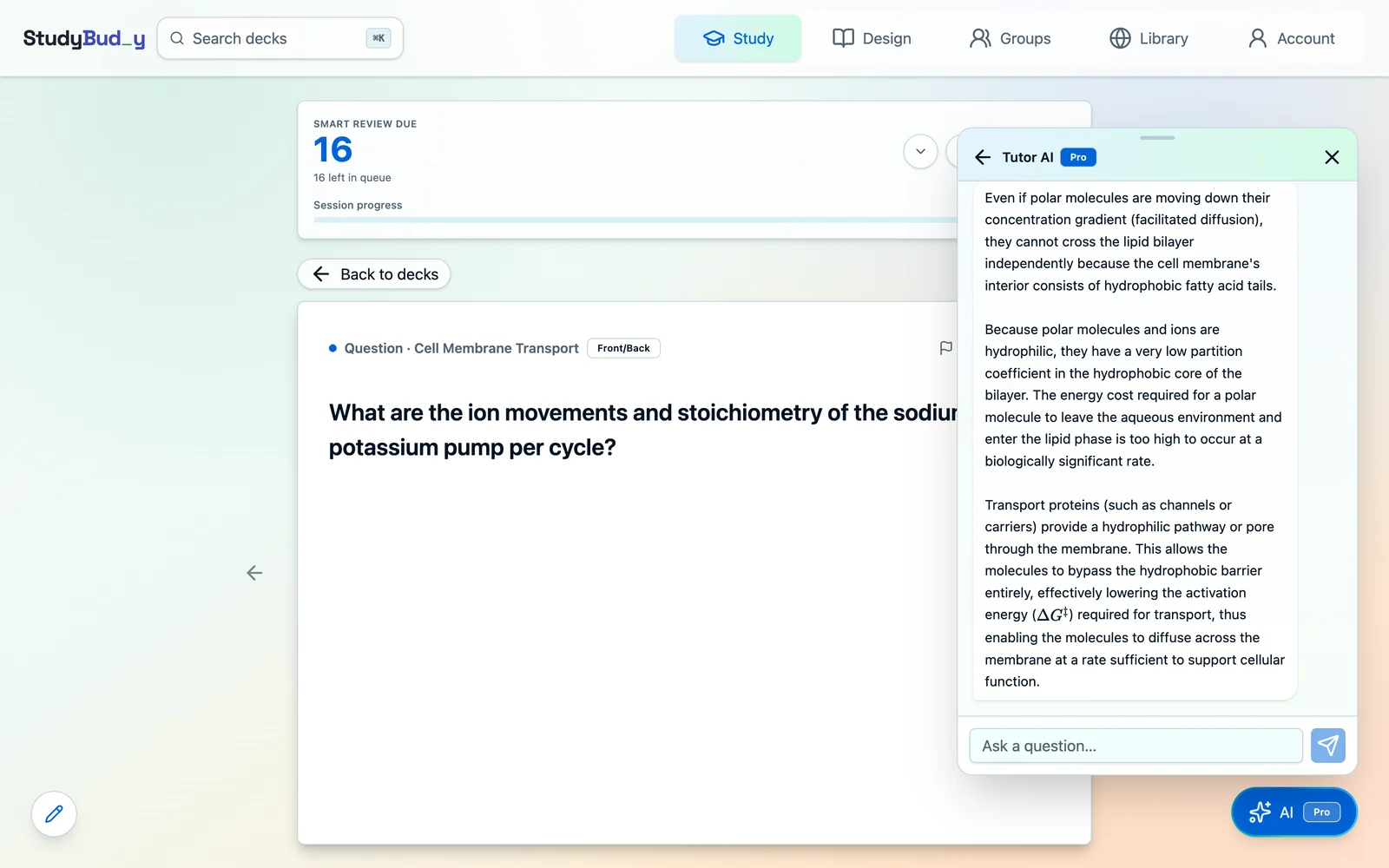
A card teaches you one route to a fact: this cue, that answer. Recall it enough times and you learn the route rather than the idea — which is why an exam question phrased differently can miss entirely.
For the concepts you genuinely need, build a second and third card that approach the same idea from a different direction: a comparison, an application, a worked case. Each one is another way into the same memory.
StudyBuddy can do this for you, using the rest of the deck as context so the new cards fit the topic instead of drifting.
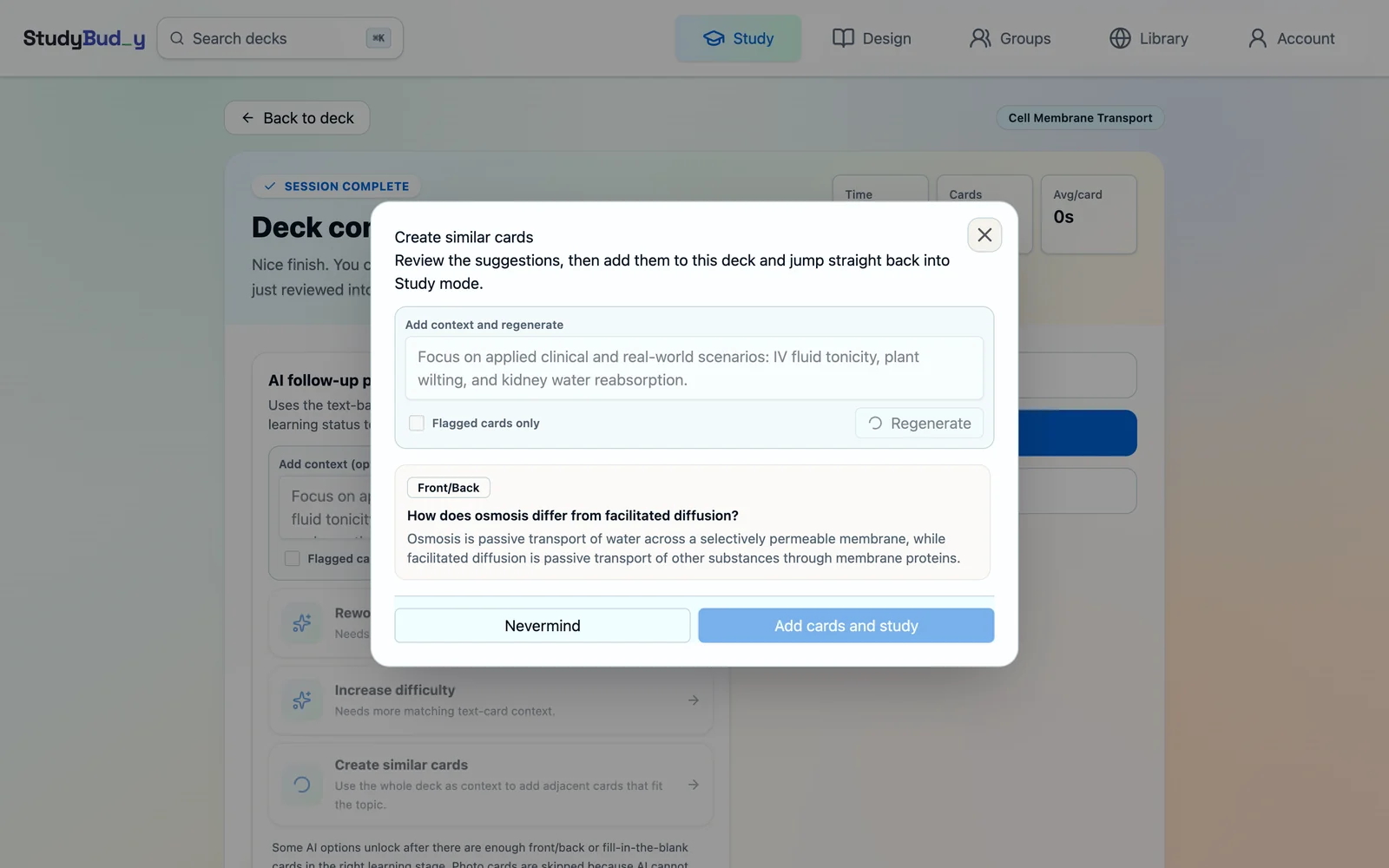
The caution: variations help when the underlying idea is solid and hurt when it isn't. Three near-identical cards on a concept you're shaky on will just interfere with each other. Add variations to your strong material, not your weak material.
A worked before-and-after
Here's a card of the sort that ends up in most decks, and what to do with it.
Before: "Osmosis — the passive transport of water across a selectively permeable membrane from an area of lower solute concentration to an area of higher solute concentration."
It breaks rules 1, 2 and 3 at once: it states rather than asks, it bundles the definition with the direction of movement, and there's no clear point at which you'd say you got it right. Three replacements:
- "What is osmosis?" → "Passive movement of water across a selectively permeable membrane."
- "In osmosis, water moves toward the side with [higher / lower] solute concentration." → "Higher."
- "A red blood cell is placed in a hypertonic solution. What happens?" → "Water leaves; it shrivels."
Definition, direction, application. The third one is the card that actually shows up on the exam.
Use images when the thing is visual
Some material is spatial, and turning it into words throws away the part you need — anatomy, diagrams, maps, chart shapes. For these, an image card where you identify labelled regions beats any amount of prose. Don't describe a diagram in text if you can just study the diagram.
Organise so you can prune later
Tags and flags are worth using from day one, not because organisation is satisfying but because they're what make selective study possible later. Tag by topic or lecture, flag anything you keep failing, and you'll be able to drill exactly the weak set the week before an exam instead of re-reviewing everything.
8. Prune. Regularly.
Decks accumulate. Cards that were useful in week two are dead weight in week ten, and every one of them still costs you reviews. If a card is trivial, duplicated, or no longer on your syllabus, suspend or delete it — suspending is reversible and keeps the card out of your queue without losing it.
A 200-card deck you maintain beats a 2,000-card deck you dread.
A quick test
Take any card in your deck and ask:
- Does it test exactly one thing?
- Could I answer it correctly without understanding the concept?
- Would I be able to rate myself honestly on it?
- Do I still need it?
If a card fails any of these, it's costing you more than it returns.
Keep reading
If you're generating cards rather than writing them, the AI workflow post covers how to keep quality up. For the scheduling side, see how FSRS decides when each card comes back and how many cards a day you should expect.