This question usually arrives in the form of anxiety: someone opens their app, sees 340 cards due, and wants to know what the correct number was supposed to be.
The uncomfortable answer is that your daily review count isn't really a decision you make today. It's a consequence of decisions you made three weeks ago about how many new cards to add.
Why reviews are mostly out of your hands
Every new card you add doesn't cost you one review. It costs you a review today, another in ten minutes, another tomorrow, another in four days, another in two weeks, and so on — a long tail that only thins out as the card gets easier.
You can see the shape of it on the rating buttons during a session: each option shows when that card will come back.
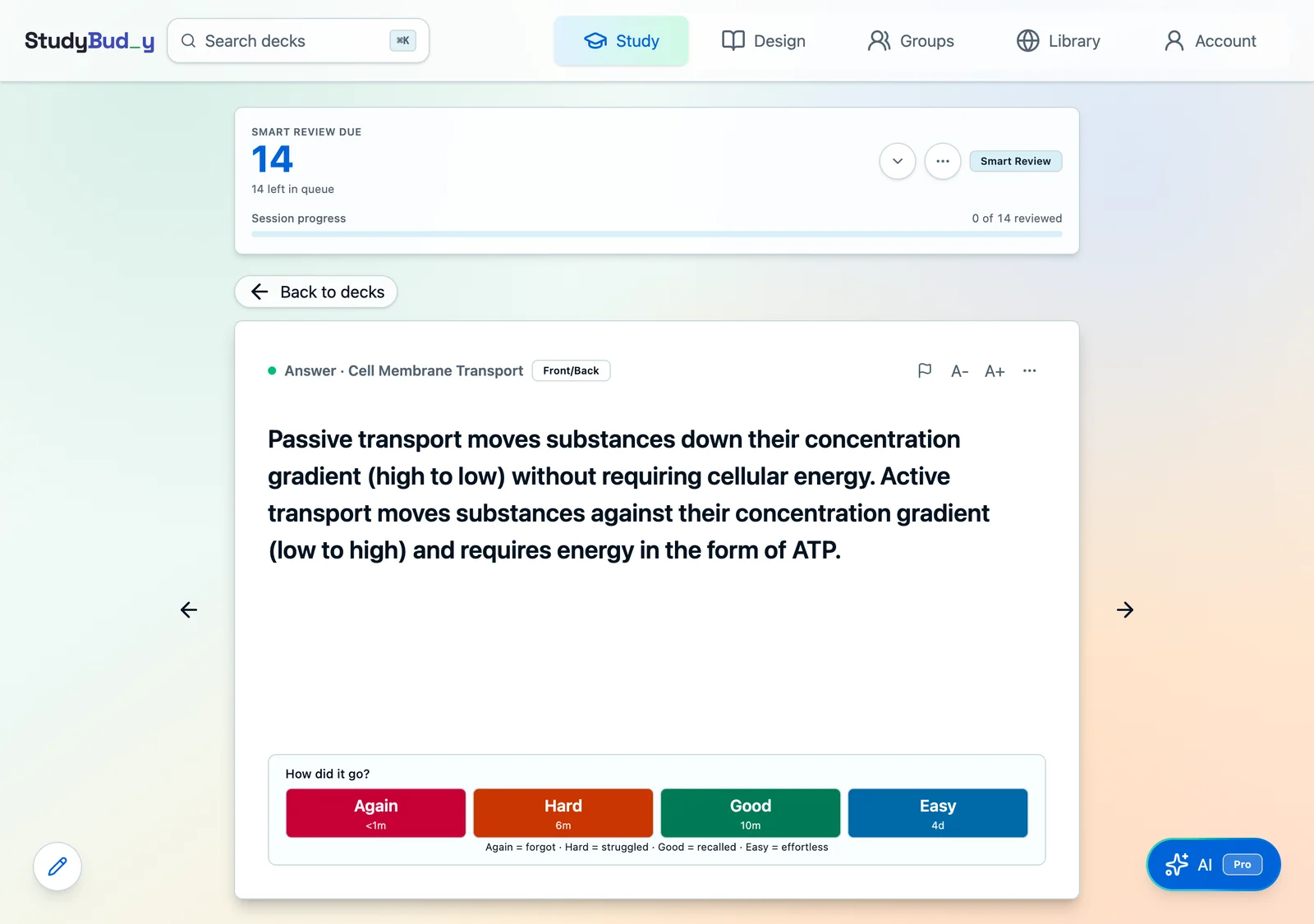
Add ten cards a day and each one is quietly scheduling future work. Reviews accumulate, then plateau once the oldest cards space out far enough to leave the daily queue.
The rough arithmetic
As a planning heuristic, steady-state daily reviews land somewhere around 8 to 12 times your daily new-card rate, once a deck has been running long enough to settle. It varies with difficulty and how honestly you rate, but the shape holds:
| New cards/day | Steady daily reviews | Realistic session |
|---|---|---|
| 5 | ~40–60 | 10–15 min |
| 10 | ~80–120 | 20–30 min |
| 20 | ~160–240 | 40–60 min |
| 40 | ~320–480 | 90 min+ |
Read that table backwards. Don't pick a review target — pick the session length you'll still be doing in November, and set your new-card rate to match.
Why week three is when people quit
The first two weeks of a new deck feel great. You add cards, you review them, the sessions are short, everything is under control.
Then week three arrives and the queue is suddenly three times bigger, because the cards from week one are now coming back alongside everything newer. Nothing went wrong — this is just the long tail arriving. Most people read it as failure and either abandon the deck or double down and burn out.
Knowing this is coming is most of surviving it. Set your new-card rate for the week-three load, not the week-one load.
One card is not always one review
A detail that quietly inflates queues: fill-in-the-blank cards with several blanks become several study cards. Hide three terms in one sentence and you've written one card but scheduled three, each with its own due date.
That's usually what people are running into when their review count is much higher than their card count suggests it should be. It isn't a bug — those really are three separate things to recall — but it's worth counting properly when you plan.
Where to actually set the limit
Because this is a per-deck decision, the caps live in each deck's scheduling settings: new cards per day and reviews per day. A daily cap is what stops one enthusiastic evening from producing three brutal weeks.
Your due counts then show up per deck, so you can see the load before you commit to a session.

When the queue has already run away
A backlog of several hundred is recoverable, and the instinct to clear it in one sitting is exactly wrong — a marathon session produces bad ratings, and bad ratings reschedule everything badly.
- Stop adding new cards. Not forever, just until the backlog drains. This is the only step that addresses the cause.
- Suspend what you don't need. Old modules, finished units, cards for an exam you already sat. Suspending is reversible and takes them straight out of the queue.
- Do one normal session a day. Same length as always. The backlog shrinks faster than it looks, because every card you get right jumps weeks into the future.
- Rate honestly anyway. Pressing "Good" on cards you actually failed just moves the problem into next month.
The retention dial, and why raising it costs more than you think
Each deck has a retention preset — lighter, balanced, or more intense. It sets the target probability that you'll remember a card when it comes back, and it's the other lever on your daily workload.
Raising retention feels obviously good and is usually the wrong instinct. Pushing your target recall higher means shorter intervals on every card, which means more reviews per day for a modest gain in accuracy. Unless you're preparing for a high-stakes professional exam, the balanced setting is the better trade.
Leave it alone unless you have a specific reason, and change your new-card rate instead.
Consistency beats volume
Twenty minutes every day beats three hours on Sunday, and it isn't close. Spaced repetition assumes you show up roughly when the schedule expects you; a weekly binge means every card is either reviewed far too late or crammed far too early.
The most useful number to watch isn't reviews per day — it's your streak, because it's the only one that tells you whether you showed up at all.

What a finished session should feel like
A well-calibrated session ends with the queue empty and you not dreading tomorrow. If you're regularly stopping partway through, your new-card rate is too high for the time you actually have — not a discipline problem, an arithmetic one.

So, a number
If you want one anyway: 100 to 200 reviews a day, from 10 to 20 new cards a day, is where most students land when studying a full course sustainably. Below that you'll under-cover the material; above it, most people quit within a month.
Keep reading
If your reviews feel heavier than the numbers suggest, the cards may be the problem — see the eight rules for cards that stick. For why the intervals look the way they do, read our explainer on FSRS. And if there's an exam in a week, here's how to handle the last stretch.